I have a tumblr blog and an Etsy shop.

Find me on twitter @Sophieamyart
Showing posts with label creative careers. Show all posts

Sunday, 9 February 2014

About the Artist

This is a quick blog about me, my life and how I got into art. It is quite narcissistic and has lots of photos - you have been warned :)


First of all my name is Sophie, I live in essex with my parents, siblings, boyfriend, 2 dogs, 4 cats, maxi cob, corn snake, crocodile Skink and Leopard Gecko.


Me aged 9


I have been drawing and painting for most of my life, being dyslexic meant that colours and shapes have always made more sense than letters and words.


A shetland, drawn by me aged 7


I managed to pass my GCSEs with better grades than expected and finished 6th form a few years after that. I had never considered going to university but suddenly I was presented with the opportunity to do so.


I experimented in my foundation year with colour, sculpture and paint, having stuck to skin tones and graphite due to shyness during school.


After my foundation year, I got into the university I wanted.

In the first week we were asked to do an art exercise - pull an item out of your bag a create a project based on that item. I pulled out a small perfume. I made a project on the impact of smell on memory and nostalgia. I picked a huge metre canvas and started my first oil painting.


I drew and (partially) painted my first animal in 9 years and loved it.

It was another year before I gained the confidence to draw a horse again. I was a weird kid in school - being horse obsessed and having a learning difficulty that meant I was mildly bullied for a year or two. It was enough to knock my confidence, making me stop my constant equine doodles at the age of 11.


My whole year held an art exhibition just before our graduation. Before the exhibition had even opened to the public all my paintings had sold, it was at that moment that I realised more people than just myself and my family (who might be slightly biased...) like my work.

I graduated in July 2013 with a 2:1 and the rejuvenated love of animals, colours and paint.


I am now making the first few cautious steps towards making a career out of making art.

Friday, 31 January 2014

Choosing a colour for your pet.

Quick warning - this post will have lots of photos in, so may take a while to load.

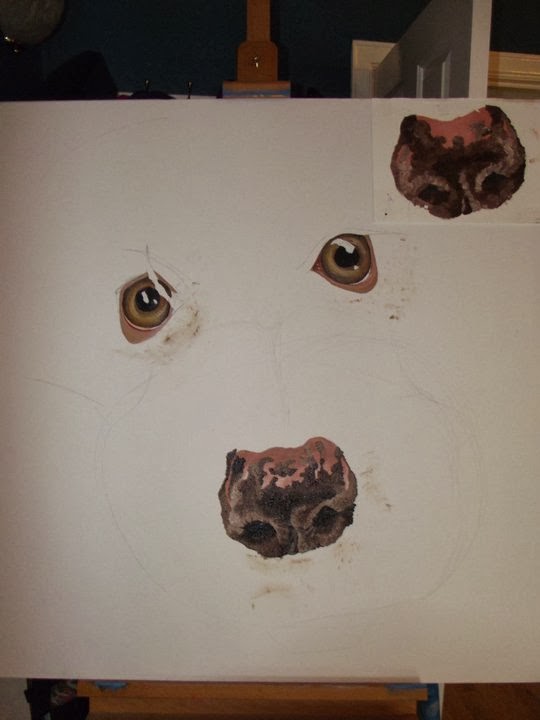
Choosing a colour for your painting can be tricky. I know from experience as I have half finished painting of my dog Maisie that has taken 4 years to even get this far.


The easiest way to decide on what colour to get painted is to look at what colours you automatically choose for your pet.

For example - my boy Jacko wears either red or different types of blue. Since the way I paint means red is actually pink I could easily narrow my decision down to blue shades. My favourite type of blue is the tone right in between blue and green - so turquoise. This makes my process seem quite long winded - but it was a very quick decision in reality


This type of choice isn't fool proof - chestnut horses generally look amazing painted pink, but people often find pink rugs and head collars clash with their rich coat.

Another example is with my two dogs. They are very different personality-wise but wear quite similar colours.


Maisie - under all her fluff has a red collar.


Alice has a pink harness but also a purple collar (because accessories...)

Maisie doesn't suit pink. at. all. While Alice suits almost any colour, So (when I get around to painting them) I think I will simply swap their colours over - Alice a naughty candy pink, and Maisie a royal purple.

Another thing that can often dictate what colour will look good is the photo itself. The paler, more subtle colours that have gold or orange tones really benefit from photographs that have lots of highlights.

Photos where half the face is in shadow, and half in strong light, like in this photo of my super fluffy cat.


Hope this helps everyone make more confident colour decisions.

Wednesday, 4 September 2013

Miniature Portrait Pricing Plan

I have been debating for a while how to encourage multiple sales of my portraits, not because I'm greedy, but because I think they look great as a "herd" like my degree show.


At £200 a pop, this is a pricey option.

So I have listened, sketched and practiced to develop a series of smaller sized portraits.

The practical information about sizes can be found here.

The Prices.

10cm - £20


15cm - £25


20cm - £30

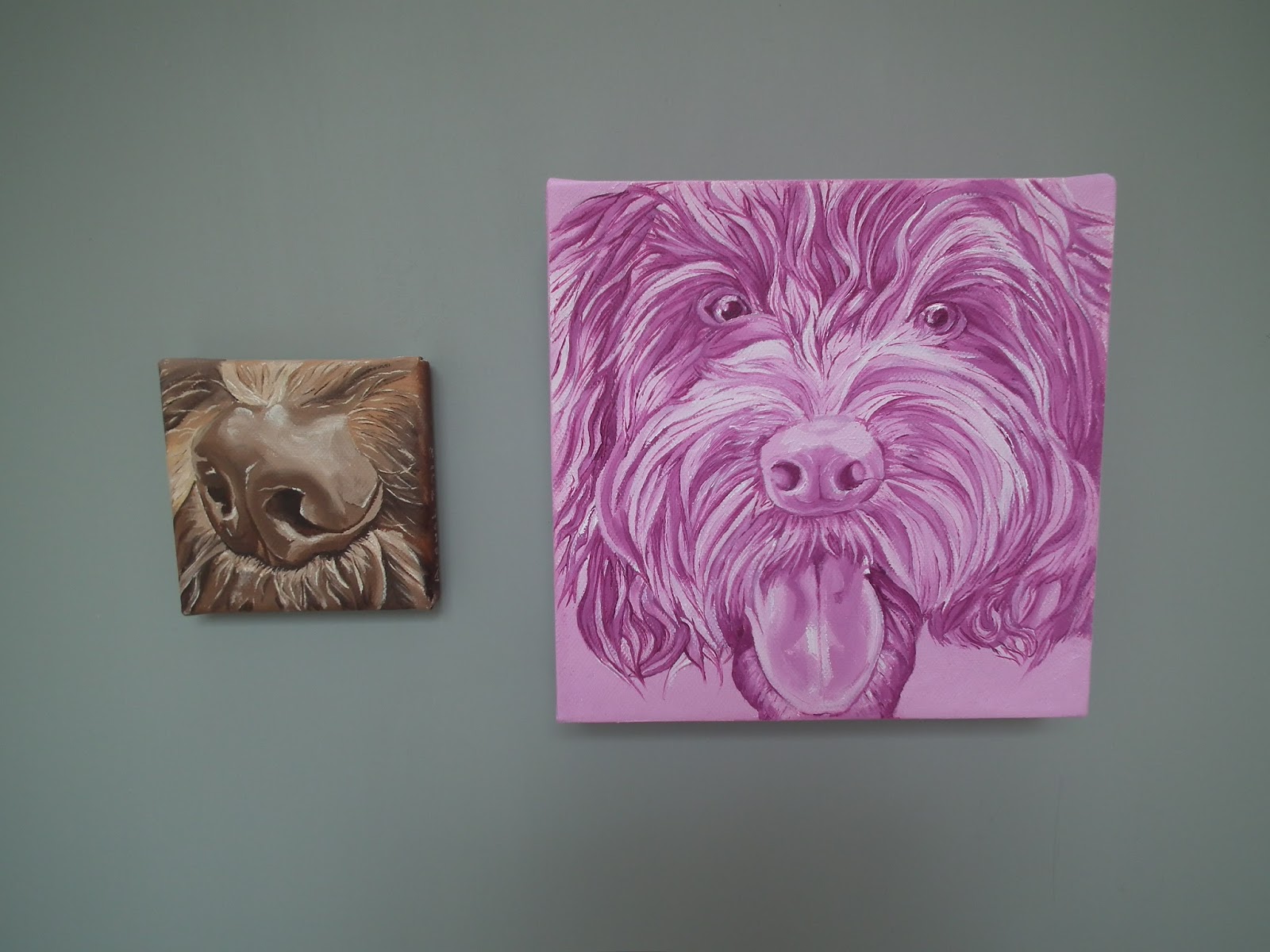
I have also started to slowly incorperate "real colour" back into my portraits since they look very nice next to a bright coloured portrait of the same animal as seen here.


However these take much longer to complete so the real colour portraits are 50% more expensive. I also only offer real colour on these three sizes.

Real Colour Prices

10cm - £30

15cm - £38

20cm - £45

The Deal

When you buy three (or more) portraits you get 10% off the total.

This include the larger portraits I have been doing previously.

Examples


15cm+15cm+20cm = £80-£8=£72 in total


10cm+10cm(real colour)+20cm = £80-£8=£72 in total


Wednesday, 12 June 2013

June Portrait Competition

What you will win:

The winner will receive a free portrait of their horse or pony.

Details

It will be in any single colour they choose.

The portrait will be a "head and shoulders" painting of one horse or pony.

If the winner wants more than one portrait I will offer very good discounts for the winner.

The portrait will be 18 x 22 inches.

See here for example work.

How to enter

Like and share my facebook page.

How do you know if you are the winner?

The winner will be announced on the 24th of June on my facebook page.

The winner will also receive a facebook message by 1pm.


Monday, 10 June 2013

Degree Show and Beyond...

The unthinkable has happened, I have (nearly) completed my third and final year at university.

We had a wonderful degree show, with a full and lively private view and a really fun show at The Old Truman Brewery.

It has been a fabulous experience and I feel able to make the first steps into adult life.

Overview of my entire piece titled My Death Bed.


It may not seem the cheeriest of titles but it is about the importance of childhood memories during a person last moments of life.

It was brilliant fun and has got me itching to do another show.

Thursday, 28 March 2013

Conversation Starters

I want to give a few suggestions on how to approach someone about buying your work. Not necessarily big gallery owners, but everyday people who would probably love to have a piece of your art hanging in their home or office.

We can often talk ourselves out of a sale, either by talking too much and listening too little or by being too honest about our work and putting people off.

You want to make sure your art is right for the person, are they your target audience?

Ask a few simple questions evolving around "Who, what, where, why, how". The best form of listening is to ask questions, let the person sell themselves your artwork by using carefully phrased questions.

Let's say I approach a person looking at this piece of work.


The kinds of questions I would ask would be aimed to the person both bout the subject and about the art as an object.

First the animal related questions. Show an interest in their interests, find out a little bit of information about them while maintaining a friendly conversation.

1) Do you have a horse?
(Allowing me the chance to sell them a commissioned portrait.)

2) What's his/her name/colouring/breed/age/sport?
(I would point out a painting, if I have one, where the breed or colour is featured. It would allow me the chance to explain about how bright colours describe the horse more than the natural colours)

3) How many Pets do you have?
(I can use this to see if I could sell them a commissioned portrait where both their pets are featured, or whether their pets have very different personalities and I could paint two portraits at a special price)

Next the more arty questions. Talk to them about the practical side of owning artwork.

4) What kind of colours do you like?
(Some people who are inexperienced in art may feel pressure to pick the "Right" colour when talking to an artist. This is your chance to reassure them that there is no wrong answer. If they blush slightly when they tell you most of their home is beige, speak honestly about how subtleties in colour can be just as interesting as bright brash colours. If they are really unsure I could ask what colour stable rugs they have on their horse, or what colour their decor is at home or their office.)

5) Do you own any art?
(being a persons first art piece is a huge deal, be friendly and reassuring. Their art may need to be more personal than stylish)

5) What other artists do you like?
(I would only ask this is the person viewing my work has shown to be rather arty. You may learn about other artists who are doing similar work to you)

6) Who is the painting for?
7)What is the painting for?
(Quite similar questions, letting you know more about the person buying your work, and it's friendly as well as informative. It will let the person buying your work know that you love your art and want to know it's going to a good home)

8) Where were you thinking of hanging this piece?
(People want art to decorate their house or office, so acknowledge this. If they say they would like it for their office space - ask them what their job is. Their line of work could be related to your subject and if this is the case ask them whether they would be interested in you offering them a discounted price in exchange for displaying your contact details)

9) Do you prefure traditional or modern style art?
(This vague and undetailed use of artistic language settles the person, making them feel them can discuss art through basic terms such as "colourful" rather than getting into the depths of art history. It helps if you have visable examples of traditional and modern art. So the person is making a choice between two pieces rather than two vague styles)

10) Do you have a budget in mind?
(One of the trickier questions to ask. Only ask this when you are pretty sure the person is a serious buyer. Don't be too rigid on your pricing so it allows for some flexibility. Also have a range of work in at least two different price ranges. This also allows you to offer them artwork that is within their budget, making your art more easily accessible to them)

You can apply this is any art form of any subject matter, not just my cute little candy ponies.

Why people buy Art

Or more importantly, why do people buy your art?

I've wanted to cover this topic for a while but it's a slippery little sucker of a topic to pin down.

I don't want to talk about taste and why people buy particular art, I want to talk about the basics.

I think at the bare bones of it - people buy things they can't make themselves.

I'll tell you a little story to illustrate this and at the same moment be the barer of bad news - cupcake sales are drastically dropping. This is because they went from being a fabulous little cake you buy as a beautiful treat to a normal little cake you learn to make yourself instead.


Cupcakes became too accessible and people became too wise at their easy-to-bake ways.

The same is said for almost all other products. Can't grow food yourself? Buy it. Can't knit yourself a scarf? Buy it.

It even applies to things that you do actually kind of do make yourself, if you can knit yourself a scarf, you still need to buy the wool. And even if you have your own sheep farm - where you harvest the wool and make your own yarn you still need food for the sheep, and you need to buy that from someone. No one is fully self sufficient.

Someone will buy your work if they honestly feel they couldn't make it themselves.

They buy it because you have a particular viewpoint that they relate to but can't emulate. This could be your materials, or the message you portray through your art. Whatever it is, people buy it because you are passionate and talented - and I think that is a very important thing to remember.

Thursday, 24 January 2013

How to talk to a Gallery owner

There is lots of really good advice on the Internet and in books on how to get your art work into a gallery and also how to majorly fail at it.

The thing is, if you follow the advice and keep showing up at your desired galleries open exhibition, visiting exhibits numerous times and become a familiar face you will eventually meet the gallery owner or the galleries curator. And what do you say to them?

Usually you will majorly panic. You will remember that all the advice said how busy they are, how they can only afford a small attention span because of how many other artists are vying for their attention.

To demonstrate my point I will role play a scene from what would happen if I walked into a gallery and the important, career enhancing person I had been slyly searching out for months turns to me and speaks to me.

Art Person - Hello again, you come here quite often.
Me - Yes, I love your gallery.
Art Person - Why thank you. Do you buy art, make art or only come and look at it?
Me - * very nervous laugh* I make art. I'm an artist.
Art Person - Oh really, what kind of art?
Me - *Verbal diarrhea*

Basically I would tell the very important person my entire life history, babble on about my subject and materials at high speed for about a minute until they run away, slightly frightened and most importantly - not remembering anything I told them because I said too much too quickly.

Which is kind of what happened at the Marketing Seminar.

I panicked big time. We were set the task of speaking for a minute, giving a business pitch to the most important client we could possibly imagine who has just stepped into an elevator with us. Hence its name - The Elevator Pitch.

Suddenly the whole days advice went out the window.

The only thing I did do right (for the task) was I identified my audience. In a gallery setting this might not work quite the same, but asking "Are you mr/mrs gallery owner?" would be a really good start. I stood up in front of the table and started.

"I'm Sophie and I'm a Fine Art student. And you, my audience, are all here to buy lots of art from me."

That was literally the most coherent bit.

People laughed because it was cheeky and made them believe for a split second that I wasn't as nervous as I really was. Humour shows you are confident and also builds your rapport with people, putting them at ease. You could emulate this by answering something along the lines of "The kind of art you would love to own." or "The kind of art that would look really good hanging right here" and pointing at the wall and laughing with the person (hopefully they will laugh) and saying "only joking, I make such and such art"

After everyone finished the task Clarke gave us some more advice. He wanted us to write a headline. He asked us to imagine it was the subject field of an email we would send, that we want lots of people to open. I used it to summarize my art work into a short sentence that gives enough information for the person I'm speaking to to actually understand what I'm saying but not enough information that it sounds too technical or dull. It makes them (hopefully) want to know more.

So anyway mine was this - I look at whether surgical thread and dusty old coffin covers can be beautiful.

If you replace the last few lines of my previous role play with this one it has a better outcome, maybe the gallery owner will laugh and ask where I got my hands on coffin covers or maybe he'll simply ask if they can be made beautiful, to which I willl reply "yes". Either way I will have permission to carry on talking rather than just bombarding them with rushed, nervous words.

Wednesday, 23 January 2013

Life's a Pitch and then you Buy: Part 1

Good Evening Chaps and Chapettes,

I've been to a business seminar / Marketing day today with the very charismatic Steve Clarke. I went with my mum mainly because she went to a talk by him a few months ago and said he was really interesting, really motivating (which I suppose is why he's a motivational speaker).

I found the day quite tricky to relate to, everyone in the room was a business owner and I wasn't. I felt like a bit of an impostor sitting there. A student, not an employee and certainly not an entrepreneur.

He used a lot of acronyms which I found a little daunting, he even inceptioned the acronyms so that the T (Tonality) in P.I.T.C.H. had to be explained by the acronym A.V.K. (auditory, visual, kinesthetic).

But I had my own light bulb moment (or eureka moment, which he also turned into an acronym by the way). I do have a business. Or at least a product.

I'm an art student, an art maker, an art seller. My business is art and the selling point I'm trying to push isn't that my art is the artsiest or the most colourfulest; it is the content and meaning behind my work. It is my materials and it is the quality of their physical aesthetics.

I'm a business owner.

In a way.

Moving on, this blog post isn't about what a clever sausage I am, it's about passing on advice and it starts with a little list of acronyms followed up by my personal take on why they help artists. Be aware they kind of repeat the same advice, but you can Tailor them to make them useful to you.

I'm also going to break down some of the more complex subjects into other blog posts, but I will still write briefly about them in this. If I write something that seems a little "easier said than done" the likelihood is I'm writing a more in depth post about it. I'm going to rely on bold text to highlight key points since this is quite a substancial chunk of text.

Starting with his EUREKA acronym

E - Engage a Hungry Audience. If you find someone (gallery or person) know how to promote your work rather than turn them off. They're "hungry" for information and are interested, don't blast them with knowledge, have a short business pitch prepared that sums up your work and your interests in a short, snappy minute or so. I'm going to talk about this a bit later.

U - Uncover the Pain. I was a little baffled by this one, but basically find a need that you can fill with your business and your product. Admittedly this one works better in a business where the reason for buying a product of practical, why people buy art is a matter of taste rather than necessity, and the reason people buy your above anyone else's specifically is an abstract and hard to pin down concept. I might write a post about why people buy art later.

R - Reach and Rapport. This is where you make sure you reach the right audience, if your art is about a particular subject find an enthusiast about the subject. Or if you use a particular medium find collectors and galleries who want your medium, and once you do establish a common interest and try to make them like you and listen to you.

E - Establish Credibility. Find your unique selling point, what makes you special and sell it in quite sparing numbers. Make your product a coveted product that is easy to access but also don't under price your work. Make your product exclusive and unique.

K - Key Elements of Every Sale. This is explained quite simply when I say that you need to hit certain targets when you try to sell, but the dynamics and balance are tricky. It is better explained by Clarkes 6 Step Sale Cycle which I will talk about in another post shortly.

A - Attitude and Action. Have the right positive, winning attitude, believe in your work and also follow up business leads. If someone has said that they want to talk to you about your work, or that they simply must see the latest pieces of your work call them or email them and make it happen.

The next acronym is shorter, but a little more complex. I found it very tricky to relate to my art, so I will explain it in terms of another business. The wonderful Care at home summarized it very well. Firstly the acronym is F.A.B. which stands for Features, Advantages and Benefits. This little acronym is perfect for knowing how to explain your art work to someone without over doing it.

Feature - This is essentially what you sell as a service or a product. Mine would be either "Art using textiles from the funeral trade" or the shorter option of "Art about Death", since these are features of my work.

Advantage - This is the advantage for the customer. Mine was regarding my university project, that the work about death comes from a "Knowledgeable source, because of my family background". I not only have an interest in death, I have very extensive knowledge in the matter from a privileged vantage point.

Benefit - This was the hardest of the three to answer, how does my work or products benefit my buyer? Again it comes back to the tricky question of why people buy art. For me I thought about the reason my art would be bought, that they have an interest in my chosen subjects and topics. So the benefit would be that buying my product gives the client "A way of looking at Death that is removed from the reality of it, but also deals with is in a very direct but staged manor." It isn't snappy or short, but my work is quite honest and blunt, but the soft edge of art gives it a comfortable platform for people to view it from. It allows topics to be personal without being hurtful.

The man from Care at Home had a much cooler F.A.B., so I'll tell you his too for comparisons sake.

F - Fully trained Carers.
A - Your loved one gets the best care possible.
B - Peace of mind for everyone involved.

I think this is a great example. It makes it so clear to see, this is the type of thing you would say to someone who is commenting on your work and you are struck with the urge to spew truckloads of information at them. It makes you clean and concise as well as professional. It will help you build rapport with people, if you know why your product or art work is so desirable.

I'm going to write a few other posts in the next few days.
- Explaining Clarkes 6 Step Sale Cycle. But to pitch to people about your product without preaching at them.
- How do you advertise?
- How to sell by listening.
- 10 conversation starters that may get you business.
- Elevator (One minute) Pitch and develop a headline to impress gallery owners. This includes advice on how to know what kind of audience you're talking to.

Monday, 26 November 2012

Example Simple Business Card

My business card is very simple with minimal information on it. It isn't very exciting and would do it much differently now but I got over excited making them.

I would definately include much more colour but leave the text more-or-less the same.

I'm going to pop up a trial business card that I will make when I use up all my current ones.


Incase you are wondering what the weird smudges are its where I crudely took off my phone numbers and email address.


UK Art Competitions 2013

This post is a list of art competitions that I want to keep my eye on over the next few years.

It's subject to being changed and added to as I find more competitions. I think art competitions seem like lots of fun so I'm going to go for a couple this year and even more once I finish university.

I'm going to try and cover a wide variety of mediums (from found object work to photography and everything in between) but obviously I might miss some by accident. Feel free to tell me about any I should include.

The competitions are ordered in relation to their submission deadlines.

1) 31 December 2012 Environmental Photographer of the Year - Photography only.

2) 11 & 12 January 2013 Lynn Painter-Stainer Prize - Painting and Drawing only.


3) 31 January 2013 Parliament Art House (Primary School Students only) - any 2D medium.

4) 28 February 2013 Discover Wildlife - any medium except photography.

5) 2nd April 2013 The Lumen Prize - any medium.

6) 11:59pm on 1 July 2013. The Derwent Art Prize - Pencil Only (graphite and colour).

7) 2013 Date not posted yet. Salon Art Prize - any medium, including sound - new competition details coming early 2013.

8) 2013 dates not posted yet - but calls for entrys begin mid december. BP Portrait Award - Paint only

9) 2013 Date not posted yet. Photography and Artwork.com - Any Medium.

10) 2013 dates not posted yet. ING Discerning Eye Exhibition - not sure about mediums as threy haven't released the info for the 2013 competition.

11) 2013 Date not posted yet. Brick Lane Gallery - Any Medium.

12) 2013 deadline already closed so apply for 2014 exhibition - details not posted yet.Cork Street Open Exhibition - any medium that doesnt need electricity to run.


A good website to visit for exhibition dates is isendyouthis.

A good Blog for competition dates called Making a Mark.

Thursday, 22 November 2012

Practical Advertising for your Art

I am desperately lacking in ways to advertise my art work. At the moment it relies almost completely on word-of-mouth, which is nice because I know the people who promote me are truly passionate about my artwork.

However, I want to reach a wider, larger audience for both my pet portrait work and the type of art I am creating as a university project - which is much more personal and experimental.

So I got researching.

Currently I have tried a small bit of self promotion with limited success. There are many websites, blogs and books with tips on advertising and I am actually going to a lecture in January with my mum on the topic but I am going to write this blog today about things I have either tried or am going to try over the next year.

Business Cards

I have got a little box of a few hundred business cards - heres a photo of them, They're pretty basic. So I'll give the first bit of advice here make batches of cards rather than bulk amounts. If you have a large assortment of work it can be tricky to summarise this with just one piece. I suggest thinking about what you are going to use your business cards for - who is going to receive them.

So either make very simple and elegant cards with quality card, or even fabric. Maybe emboss the cards with just your name, website and phone number. I consider this to be for more established artists who are getting regular shows and selling quite a large amount of work. Or an artist who has more industrial or minimalist work.

Alternatively use numerous examples of your work for a number of cards - say as an example you make equal amounts of paintings and sculptures and you want one hundred cards - get half printed with a sculpture image and the other half with a painting. You could even choose a few paintings and a few sculptures so if the cards are spread out on a table at an exhibition visitors will be able choose the card with the art they like on it.

Don't get too carried away with making business cards though - don't get too many printed out at once as if your working style changes you haven't got a surplus amount of out-of-date artwork. I can say this for sure because I have around 300 cards advertising my graphite drawings when I much prefer making oil paintings now.

Make a book

This isn't to give out to potential customers like business cards but it is helpful to put in waiting rooms and on coffee tables with places you have a good relationship with. These don't need to be specifically "arty" places either. I'm considering making one to see whether my dentist would put it in their waiting room - they are animal mad and are close family friends. But it could be a cafe, restaurant, hairdressers - I could potentially have one in my parents waiting room of their business, since I have also made most of the artwork currently on their walls and could include this in my book.

rightbrainrockstar.com has a blog on the topic but I think he links to an American book making website, here's a link for UK version.

These books are also something you could sell, I haven't ordered one so I can't say what kind of quality they have but I'm sure it isn't bad. I'm particularly interested in this because in my second year at university I bound and hand printed my own book.

Start a Blog/Website and keep it up to date

This is important not because it raises your google rating (which it does) but because when someone takes your business card, or reads your book in a waiting room and they visit your website to learn more they want to see a nice easy to understand website.

My website is admittedly not that up to date, and I would be more willing to direct people to this blog but that is because I am not entirely happy with the website maker I made my site on, it's quite glitchy and complicated on some issues and too limited on others - although it is free for a year and does the job until I want to splash out for an expensive site. I am going to buy the web-address and make the site from scratch I think.

Visual Art Trader gives you your own artist website when you join so this is also a really good option for any artist unless you want a personalised URL like mine.

The only other issue with your website is that the general public won't stumble onto your website through google - and if they do you can't guarantee they want to buy your work. So you need another form of promotion to direct traffic to your website.

Another really good method to gain fans and perhaps even customers is through social media like facebook or twitter. Facebook is basically an online version of word-of-mouth promotion. If one friend likes your work all their friends can see it so you have a huge potential audience. It allows you to engage with your audience rather than having a one way conversation like on this blog. Questions and answers can go both ways on social media.
See my previous post on ways to make your facebook page stand out from the crowd. Or this one by rightbrainrockstar (again I know, but that site is just so useful) on artist websites.

Enter Art Competitions

Late October I started researching art competitions to enter and was disappointed to find most 2012 deadlines were in early November so I am going to start entering and making note of ones to enter early next year.

The best one (in my opinion) is the RA Summer Exhibition. My friend from my foundation course got a sculpture piece accepted and it just seems like good fun as well as good exposure.

I have an ever growing list of competitions to enter here. I will then post photos of my entries and how I do in them.

Connect with Artists

This is related to all the other tips in this post. Like artists pages on facebook, link their websites on twitter and comment on artwork you like. These relations are nice but can also be useful, if the artists work is similar to you in anyway you can use them as examples to learn from.

Speaking of which heres mine.

You can emulate successful artists and also connect with artists in a similar position to you to help you price your art, join communities or find galleries that like the kind of work you produce.

Other Reading

I will update this as I find other useful websites on promotion.

16 ways to get your art noticed


Monday, 19 November 2012

Creative Career Blogs to Read

So I've been catching up on a few other people's blogs for tips on improving my online visibility and also getting the confidence to actually consider the scary prospect of being an artist as a career. I've got a few of the best and most inspiring sites on here for anyone to have a look at.

Also I figured out how to make links properly. Finally.

So just click on the orange titles to visit the related sites.


1) 38 Amazing People who will help you quit your job and follow your Dreams.


I chose this blog post not because I have a job that I need to quit - I'm a jobless student, but the testimonials are inspirational and make me excited over the prospect of being self employed one day. It also gives a boost to my artistic dreams, which is always nice.


2) 8 Awesome Free Guides

This is a list of guides, making this a bit of an inception post - a blog list within a blog list. Also the whole site is a gold mine of really useful info - hence why it features twice on this small blog post. It has information about everything blog-related, creative career-related and many inspiring lists of things making this the main site I look into when I need to give myself a little online pep talk.

I will be using some of the practical posts it suggests and uploading the results as I go.


3) So you quit your job, now what?

Another job related blog. It's a blog about trying to figure out what makes you unhappy about your job. What makes you unhappy can be really tricky to put your finger on and knowing how to change the things that effect us negatively is something artists do quite often when creating our work to our own personal standards.


4) 8 Ways to Customise your Facebook-Business page

And lastly a very practical blog about how to make your facebook page stand out from the crowd with tips on how to customise the notoriously rigid structure of Facebook.

5) Making it

This is a wonderful post from literally the coolest website EVER. It's a very positive post from people who have been-there-done-that. They took a degree (fine art) that made them feel helpless in choosing their perfect careers. It gives good advice on how to set up a portfolio that contains art you want to be known for rather than work you feel you should make, or you have made as a project for uni or college.

Monday, 6 August 2012

Reptile Sketch

So today I completed my first reptile sketch, I have drawn snakes before for my Medusa piece but not in graphite(pictures of which will be coming once I figure out how to photograph a 10 metre roll of paper, I'm personally thinking a slideshow type, where individual panels are photographed).


This is a little A5 sketch of a little brown house snake.


See more examples of my work on my facebook or my flickr account

Thursday, 31 May 2012

Possible Career Decisions

I have decided today that I would really love to be a digital designer of some-sort. I still need to email around and make a few more perminant decisions after a bit of solid advice and some more research.

I like the flexibility it gives me. I could potentially work in advertising then move to designing movie posters or book covers because the skills are transferable once you know the software.

So I've ordered Painter 12 along with a Wacom tablet. I'm going to experiment with a combination of oil painting, mixed media and then finally digitally painting the pieces.

I'm really excited for my stuff to arrive, just got to go computer shopping, as this old laptop of mine wouldn't have enough memory to hold the software and its resulting pieces of work.


In other news, the volunteer interview I went for was a bit of a waste of time. The person interviewing me was 15 minutes (at least) late, so i left. Bit of a bummer for a couple of hours driving but c'est le vie. I got to see some beautiful miniature wildflower meadows and a really healthy looking Rose Chafer beetle. So all in all it was a good day.

See examples of my work and keep up-to-date on my facebook or my flickr account

Wednesday, 23 May 2012

The first Steps of my Career

Well more like the act of packing a adorable little polka dot handkerchief.

I actually wrote a CV *gasp* and sent it to galleries who were advertising for volunteers *double gasp*

But yes, I got a reply from a nice museum who want me to come to an information session. It may seem a little redundant getting an unpaid position but with art being such a sparse jobs market any experience is good experience. and I want to get the volunteer part of art hopefully out of the way.

I'm currently working for my family's firm, making adverts and their annual calender so that's technically creative experience too. I feel like I'm heading in the right direction. Even if I'm unsure of the eventual destination.

So yes, imagine me as a little art hobo.

Although I do have less time for actual art work, I figure a painting a week is a good aim.

I have completed a white, bay and black horse and have a dun and a chestnut all sketched up and ready to rock.

I want to get the dun done *giggle* tomorrow after a short trip into uni as I'll get home earlier than if I went into work. I'm thinking a nice mustard yellow for him. I know it isn't technically a jewel but ah well. It's nice and vibrant.

Also should I have a sign off signiture?

See examples of my work and keep up-to-date on my facebook or my flickr account